Earth Connection is a school of primitive skills and wilderness survival located in Northern Virginia and North Carolina (Raleigh/Durham area) that has been in existence for over a decade. Our hands-on classes are reasonably priced because we don't believe in big price tags for primitive skills. That's just not natural!

Wednesday, April 25, 2007

2007 Lyme Disease Risk

First in our Risk Management Series is Lyme Disease.

The 2006-7 northern Virginia winter was very mild. The lack of a long freeze to kill off a healthy percentage of insects over-wintering in the leaf litter, including ticks, will definitely increase the number of biting insects this year. Since we are talking about Lyme disease, what that means for our 2007 classes is the increased risk of suffering from tick infestations and a risk of infection by the bacterium that causes Lyme disease. Although the risk of being infected by the bacterium carried by deer ticks that causes Lyme disease is low for the area surrounding Earth Connection, there is still a risk.


Facts: The Lyme disease bacterium, Borrelia burgdorferi, harbors in mice, squirrels and other small mammals. It is transmitted through the bites of specific species of ticks between themselves and to to humans. In the northeastern and northcentral United States, the blacklegged (deer) tick (Ixodes scapularis) is known to transmit Lyme disease. Other tick species are not known to transmit Borrelia burgdorferi.


Blacklegged (deer) ticks live for two years and have three feeding stages: larvae, nymph, and adult. When a young tick feeds on an infected animal, the tick takes the bacterium into its body along with the blood meal. The bacterium then lives in the gut of the tick. If the tick feeds again, it can transmit the bacterium to its new host. Usually the new host is another small rodent, but sometimes the new host is you or me.

Most cases of human illness occur in the late spring and summer when the tiny nymphs are most active and human outdoor activity is greatest. Although adult ticks often feed on deer, these animals do not become infected. Deer are nevertheless important in transporting ticks and maintaining tick populations.


Any tick-borne illness may be prevented by avoiding tick habitat (dense woods and brushy areas), using insect repellents containing DEET or permethrin, wearing long pants and socks, and performing tick checks every 12 hours and promptly removing ticks after outdoor activity. Persons should monitor their health closely after any tick bite, and should consult their physician if they experience a rash, fever, headache, joint or muscle pains, or swollen lymph nodes within 30 days of a tick bite. Failure to medically counter the bacterium can result in debilitating health issues.

Sunday, April 22, 2007

Spring Wild Edibles Class

On 21 April, Earth Connection held its Spring Edibles Class. The course focused on the different plants and plant uses of the spring season. Earth Connection instructors, Tim and Hue, walked six inquisitive students through different habitats, identifying edible plants as well as pointing out harmful plants to avoid, collecting safely with proper conservation techniques, and frequently sampling many of our wild plant foods.

These modern natives wanted the knowledge about plants as a source of food, medicine, cordage (string or rope), building materials, tools, firewood and last but definitely not least - what poisonous plants to avoid. We covered almost 40 wild edible plants, shrubs and trees. Proper identification including Latin nomenclature.

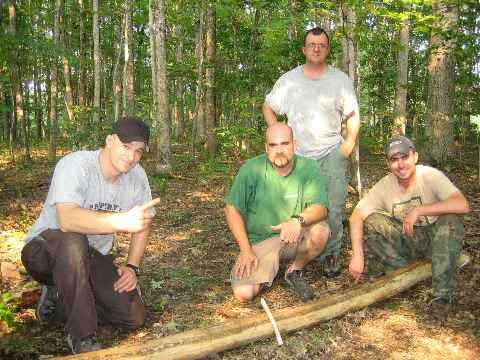
Can anyone tell me who Tim looks like here?

Wild edible snacks were served as a bonus to christen and entice our newly educated wild edible enthusiasts. July 14 is our next Wild Edibles class where we will be covering the next season... SUMMER.

19 May is Earth Connection’s next class. Our new Organic Gardening course will show you the ins and outs of certified organic gardening for the home gardener. Whether you have a farm, backyard or just a sunny patio or balcony, you can grow your own food in the safest way available. Learn about location, soils, soil amendments, composting, animal free gardening (no animal parts or ground up bones in your soils), tools, garden beds, container gardening, irrigation, seed selection, growing your own seedlings, transplanting, garden plans, crop rotation, pest control, seed saving and much more!!! Each student gets an Earth Connection gardening handout with full color photos and written plant information. If you care about the food you are eating and want to grow your own, then this class is for you.

Register Here for either class!

Wednesday, April 18, 2007

Managing Wilderness Adventure Risks

In the coming weeks, Earth Connection will be publishing a series of blog-articles on Wilderness Adventure Risks. Experiencing the wild places exposes each of us to many risks to our health and well-being. Risk and uncertainty are central to the concept of adventure and understanding these risks from the onset of your adventure will help you prepare and mitigate the possibility of contracting a debilitating disease or injury.

Just ask Tim about risk; he'll tell you about all of them... for instance, the likelihood of eating bird droppings or snail snot in a wild edible salad.

In this series we will be identifying some of the commonly-asked-about adventure risks and factors to help you decide how to mitigate the risk.

First, before we begin the series, let's cover the basics of Risk Management and Assessment.

What is Risk?
A common definition of risk is identifying a specific hazard and the likelihood that the hazard occurs (probability) x (hazard) = risk. That likelihood may be expressed as a rate or a probability. For example the risk of a wilderness accident (hazard) can be expressed as one accident per one hundred adventures (likelihood).

What is Risk Assessment?
Risk assessment is the process of analyzing potential losses from a given hazard using a combination of known information about the situation, knowledge about the underlying process, and judgment about the information that is not known or well understood.

What is Risk Management?
The process of combining a risk assessment with decisions on how to address that risk is called risk management.

Five Step Risk Management Process
Step 1 - Identify hazards
Step 2 - Assess hazards to determine risks
Step 3 - Develop controls and make risk decisions
Step 4 - Implement controls
Step 5 - Supervise and evaluate

There, now you know all about risk management, right?

Probably not, so now we have to discuss some of the specific risks you might encounter in a daily outing... say, at one of Earth Connection's classes. We will not discuss the simple risks like cutting yourself with your knife, but probably should with as many times we have seen students hack away at their own fingers at our classes. But, alas, I will keep on track.

Stay tuned for more five steps of risk management at Earth Connection classes.

If we do not discuss the risk you are concerned about then let us know so we can address it.

Saturday, April 07, 2007

Only 12 Plants of 500,000 Supply the World with Food

I recently found a very interesting fact published on Killerplants dot com

FACT: Five hundred thousand is a rough guesstimate of the number of plant species on the face of the Earth.

Of this 500,000, there are 3,000 species that provide some edible portion to humans. Edible food portions include, leaves, roots, nuts, and fruits.

Of these 3,000 species, only about 150 are regularly cultivated by humans.

(I wonder how much of the 3,000 are in the Americas?)

Of the 150 cultivated plants, only 12 supply most of the food our world consumes.

The critical 12 cultivated plants are...

Cereals:

  1. corn (Zea mays)
  2. rice (Oryza sativa)
  3. wheat (Triticum aestivum)

Legumes:

  1. common bean (Phaseolus vulgaris)
  2. soybean (Glycine max)

The roots:

  1. white potato (Solanum tuberosum)
  2. sweet potato (Ipomoea batatas)
  3. cassava (Manihot esculenta)

Sugar sources:

  1. sugarcane (Saccharum officinarum)
  2. sugar beet (Beta vulgaris)

Pan-tropical fruits:

  1. coconut (Cocos nucifera)
  2. bananna (Musa Spp.)
Add to your wild edible knowledge and supplement the critical 12 cultivated food plants.
Register HERE for Earth Connection's:

21 April Spring Edibles Class
19 May NEW Organic Gardening Class


Killerplants™ is a website for gardeners, plant lovers, collectors, and people interested in the natural world. Killerplants attempts to instill a way of rethinking our world adding a bit of respect so that it will not be lost forever. Killerplants publishes five newsletters that might be of interest to those of you who desire to learning more about the plant kingdom.


Wednesday, April 04, 2007

The Joys of Spring Edibles

The popular Earth Connection Spring Wild Edible Plant class is rapidly approaching (April 21). This course focuses on the different edible plants available in our region during the spring. We will spend copious time guiding students through our school's different mid-Atlantic habitats identifying, collecting and frequently sampling wild plant foods, as well as pointing out harmful plants to avoid.

The class will cover approximately 40 plants, shrubs and trees. Proper identification and use of plants include, whether plants are native or introduced, when and where to safely collect plants and conservation techniques. Each student will receive an Earth Connection plant handout with color photos and written plant information with plenty of room for notes. Wild edible snacks are a part of each course regardless of season and spring is our favorite time for wild food snacks. Many of the wild plant snacks are prepared ahead of time, using some modern ingredients. The wild food menu may contain some items with dairy, eggs and/or meat.


Sign up here


Saturday, March 31, 2007

Survive THIS!

Over the March 24-25 weekend, Earth Connection (EC) held its popular Wilderness Survival course that instructed 11 students on a variety of year-round life saving wilderness survival skills using modern gear and some historic & primitive outdoor skills. Tim, Hue and Jamey gathered their knowledge and delivered a two day educational smörgåsbord on how to keep your three pounds of meat (brain) alive when lost in the wilds.

Instruction included survival's rule of fours, tarp shelters, basics of making and utilizing fire, collecting and purifying water, wilderness food, staying found (not getting lost), signaling, and survival kits... to give you just a hint of the topics that were covered.

Sean B. who attended the class gave this testimonial, “Just wanted... to say again how much I enjoyed the class. The info was well presented and you struck just the right balance between serious instruction and hanging out… you guys are like the proverbial heroin dealer; i.e. get’em hooked and keep’em coming back... [BTW,] was stuck on the beltway this morning in a suit and tie looking at the roadside weeds and thinking about cordage!”

Food gathering instruction, always a favorite topic when you are hungry, include collecting and preparing nutritious edible plants, four different traps unique to this course, and survival fishing. We even dined on Jamey's delicious squirrel stew.


Sunday, March 18, 2007

Wild Food Plants dot Com

I recently became acquainted with Sunny Johnson, a wild foods’ aficionado in California, who has added Earth Connection as a wild foods instruction resource on her Wild food Plants website. Her vision is that this website will become a clearinghouse of information and resources for wild food plants worldwide. Her current project is organizing a television program on wild foods and sustainable living skills.


The Wild Food Plants website is chocked full of great wild food recipes and earth friendly advice. I'm really enamored with her wild soba noodle recipe. I highly recommend a regular visit to this website! (See the link in our Partners section on the left)

Sunny’s bio is impressive: BS in Dietetics from the College of St. Catherine, MS in Nutrition Education from the Rosalind Franklin University of Medicine and Science, and a certificate in Native American Permaculture. Her Master’s work focused on the antioxidant levels of wild food plants. In addition, she is a certified yoga instructor, teaching for over 6 years. She has also filmed, edited, and produced a documentary in 2006 called the Local Food Challenge.

Saturday, March 17, 2007

Tracking - The Art of Questions!

Tracking is a highly evolved art and science that can encompass all kinds of study subjects from physical sciences to quantum mechanics, from biomechanics (study of motion) to global/micro weather patterns, from animal behavior to human awareness, and from a life born to its final demise. Tracking is the one art that calls to one’s soul to follow that which past by here. It is the Art of Questions!


Earth Connection's Basic Tracking class is designed to give students a basic set of tools to investigate animal tracks and signs. Eight students learned the basics of animal sign, clear print identification, animal gaits and track patterns, and distinguishing track age. We also apply tracking knowledge to survival skills with demonstrations in small animal trapping.


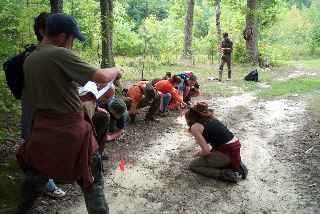
Most students favor the "Dirt Time" assignments (a deliberate study of tracks discovered in the wild) and plaster casting tracks learning that “dirt time” provides the best and quickest learning method and is the primary tool for learning the art of tracking.

HAPPY TRACKING!

Post Note: Blake recently discovered the culprit of all the cat tracks. "[The cat is] approximately 12" from shoulder to butt, black and white, [but unsure whether it was male or female]... it was heading out towards the road, crossing under the fence in the early morning." Blake observed a pitch to the left set of tracks that was consistent with the cat tracks we observed during our class. Blake commented that, "my best guess is that this little cat is going out to the field in the evening to do its hunting and coming back in the early pre-dawn hours."

Tuesday, February 27, 2007

Friction Fire Success X 16

On 24 February 2006, Earth Connection (EC) conducted a friction fire class that was one of the largest set of successful fire making we have seen. The EC friction fire class focused only on two methods: hand and bow drill friction fires. We had sixteen potential fire-makers that morning and by the day's close all had achieved the ultimate result of rubbing sticks together; FIRE!

We are proud of our newly educated pyromaniacs and expect them to practice, practice and practice friction fire making with what is in their backyard.

Fire Palooza is coming this summer when we are set to assist our student in learning a whole slew of fire making techniques.

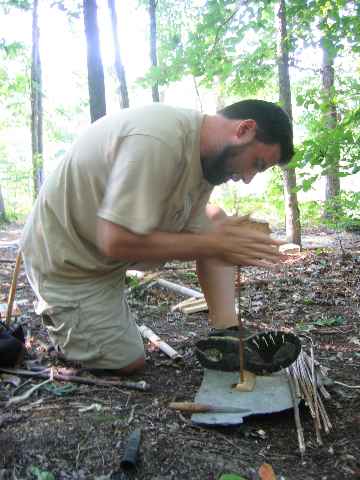
The basic technique for making friction fire involves spinning a drill in a hole on a board. Friction from "rubbing the sticks" together produces heat and carbonizes the wood into a fine powdery char. The char collects in a notch cut into the center of the hole like a pie slice. Once the char heats to ignition temperature it will form a coal and begin to smolder.


This coal is place into a bed of tinder of fine, dry plant fibers and given oxygen by gentle blowing. Eventually, as the volatile gases also ignite, this will cause the tinder to burst into flames . This is much easier to describe than to accomplish. Considerable downward pressure is required.


All sixteen of our students completed the task at hand and made a self sustaining fire. What an accomplishment!

Saturday, February 10, 2007

EC 2007 Class Schedule

What is your favorite class?

We are constantly changing our class curriculum as well as offering the classics. Keep an eye out for more class offerings in the future. Tell us what you would like to learn and we will work it into the schedule. New classes are being created all the time. Look for Land Navigation, Fur Tanning, Pack Basket classes and more in the near future.

Register Here!

Feb 24 -- Fire Making
Mar 10 -- Tracks and Sign
Mar 24-25 -- Wilderness Survival
Apr 21 -- Spring Wild Edible Plants
Apr 22 -- Organic Gardening NEW!
Jun 2-3 -- Primitive Tool Making
July 14 -- Summer Wild Edible Plants
Aug 11 -- Basketry
Sep 8-9 -- Fire Palooza
Sep 22 -- Primitive Cooking
Oct 13 -- Fall Wild Edible Plants
Oct 20-21 -- Hide Tanning
Oct 27-28 -- Hide Tanning Rain Date
Nov 2-4 -- Primitive Skills

New Websites Added to the EC Family

Earth Connection has recently published two new web sites that provide information to our students and all other primitive skills enthusiasts. The content will be growing on each site as the months go by. Please visit them often for new photos, articles and lessons.


This is in the EC tradition...

"The class isn't over when you go home!"

Basic Survival Skills for the To Shin Do Practitioner

Earth Connection recently began a new curriculum called EC Survival Strategy that provides training certification in survival and wilderness skills. We provide this service exclusively to the Chapel Hill Quest Center. The Basic Survival Weekend was held in late January.

Earth Connection through EC Survival Strategy is providing four levels in survival and wilderness skills instruction--Basic (Apprentice), Intermediate (Practitioner), Advanced (Instructor), and Expert (Mentor)--to the students and instructors of the Quest Center. This program will eventually establish Quest Center practitioners and instructors officially certified by Earth Connection's good name.
We are honored to be associated with the traditions that the Chapel Hill Quest Center is promoting.

Earth Connection in Northern Virginia Magazine

February 2007 issue of Northern Virginia Magazine has an article about Earth Connection written by nature writer Matt Kull. There is an awesome photo of Tim and daughter Megan making a fire photographed by Jonathan Timmes. Check out this issue.

We have more news coming!

Earth Connection Joins National Geographic's Wild Chronicles on PBS

EARTH CONNECTION NEWS... CHECK THIS OUT!

Boyd Matson, host of the TV series Wild Chronicles, learns how to construct a wilderness shelter. Wild Chronicles, hosted by Boyd Matson tells the story of our planet, offering rare access to unknown places and in-depth reporting from National Geographic. (Made possible by National Geographic Mission Programs and presented by WLIW New York)


Tim MacWelch and Rick Hueston of Earth Connection join longtime National Geographic Explorer host Boyd Matson and award-winning executive producer Mark Bauman for Wild Chronicles Episodes that highlight essential survival skills. In the first of several survival episodes, Earth Connection teaches Boyd how to make a friction fire.

Friction Fire episode aired Sunday, February 4, on CHANNEL 67 (Maryland Public Television). Episode #215 Titled "Bonobos in the Congo."

We will help Boyd with shelter in the next episode that will probably air in April. There will be more to come... stay tuned.

Wild Chronicles looks at the human relationship with nature, highlighting breakthrough science that offers real hope for the future. Wild Chronicles is presented on public television stations by National Geographic Society Mission Programs—the arm of the Society that supports pioneering research and field expeditions. http://www.nationalgeographic.com/donate/wildchronicles/

Forty-two "Wild Chronicles" episodes are planned for the series during the 2006-07 television season. Segments covering news from nature, adventure and exploration, scientific revelations, and stories from the field include both original reports as well as updates on some exciting recent discoveries. Earth Connection will be involved with more than six episodes during the 2006-7 television season.

Local Stations to view episodes:
  • WETA TV 26, CHANNEL 26 Arlington, VA
  • mpt/Maryland Public Television, CHANNEL 67 Owings Mills, MD
Check your local PBS provider for Wild Chronicles listings:
(Search for Wild Chronicles and read the details of the episode to find the correct episode)

Monday, November 27, 2006

Primitive Skills (10-12 Nov)

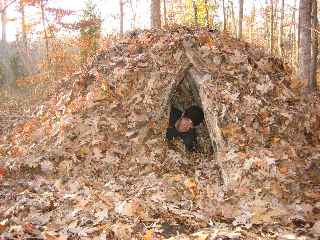
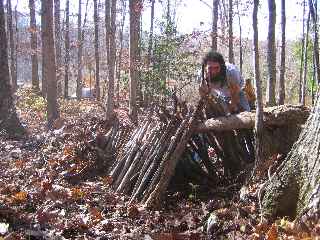
The contrasting weather brought an Indian Summer with sun and warmth the first day when we constructed our leaf debri huts followed succinctly the last day by the usual cold fall rains we encounter this time of year... you know the kind that wake you up warm and cozy in your leaf cocoon to the pitter-patter of rain falling on your leaf roof.


Well... if you made the debri hut properly only then would you wake up warm instead of cold and wet. Ask Earth Connections newest Primitive Skills Class graduates that were taught primitive wilderness survival skills. Although the rainy weather on the last day caused us some consternation, we persevered through the cold to the grand finally of basket making indoors. That's right, we wimped out to have limber hands and dry backsides to make beautiful baskets out of material we collected on site.

Note worthy:
Many of our students for this class are instructors from the Quest Center where they focus physical, mental and spiritual study in the ancient art of Ninjutsu which includes the topics that Earth Connection teaches.

What our students experienced:
Leaf hut shelter constuction, without tools or cord; friction fire making with the bow drill; primitive tool making; primitive water gathering and purification; primitive traps; rabbit hunting stick; edible plants, primitive cooking, wicker basketry from vines, plant and tree bark string, and burning out wooden bowls.

Sunday, October 15, 2006

Huge 2006 Acorn Crop

This year's Fall Wild Edbile Plants class on 14 Oct covered quite a few "delectable edibles... mmmm," as Tim commented early that morning. But, the main item of discussion was this year's abundant acorn crop.

We talked, gathered, processed and ate acorns. Jen (Tim's much better half) made delicious acorn/peanut butter cookies and acorn/pumpkin muffins that were the hit of the class.

Interesting Oak facts: A mature Oak tree can produce up to 1,000 pounds of acorns in one growing season and this year was one of those years. In fact, Oak trees produce an abundance crop only every 3-5 years depending on the species and local weather conditions. Acorns have been used as a main food staple more than any other nut or grain over the course of human history. White Oak is the most common of the Oaks and good thing too, because they tend to have less of the tannic acid that makes processing acorns somewhat laborious. The nutrition of one handful of acorns is equivalent to a pound of hamburger making it an excellent food.

Hue brought his usual edible findings for all to taste... Jerusalem Artichokes, Persimmons (fermented slightly, but still good), Acorn meal (leached of its tannins), Autumn Olive sauce, and dried Nannyberries.

Sunday, October 08, 2006

The 10 Bushcraft Books by Richard Graves

We found an on-line edition of a classic bushcraft text now out of print, 'The 10 Bushcraft Books' by Richard Graves. Richard Harry Graves, 1898-1971, is a former Commanding Officer of the Australian Jungle Survival & Rescue Detachment of the Austalian Air Force and well know Austalian survival book.

'The 10 Bushcraft Books' are considered the seminal texts on bushcraft and this on-line edition is brought to you by Chris Molloy from New Zealand who has the passion like us for the outdoors. Originally written as wartime information for conducting rescue missions, the notes were later revised and prepared for a School of Bushcraft which operated for nearly 20 years.

See the Resources List to the left. Enjoy!

Sunday, September 24, 2006

Fading Tracks

The tracks and sign of raccoon, deer, mouse, cat and lots of dog (Chagi-ya) encapsulated Earth Connect's (EC) first ever Tracks and Sign class.

"So much information to cover and so little time" was our mantra. The students (nine) were eager to learn the basics and very much appreciated the macro to micro lesson plan along with hands-on activities. Practicing the gait patterns on our hands and knees really drove home the way animals move. The "wisdom marks" sandbox really demonstrated how some tracks can age because there was a rain that occurred a week ago that obscured a fourth of the marks. We even had some great examples of aging mud/gravel deer and racoon tracks under the water of a slow moving stream.

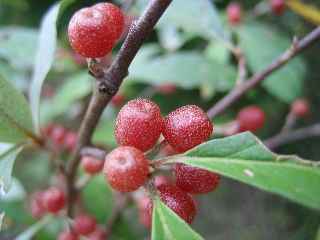
One tracks and sign story told of how mice climbed a Autumn Olive tree and chewed through many of the branches that were ladden with ripe fruit. We surmized that it was a combination of efficient use of energy by reducing the amount of climbing and to make it less dangerous to eat the fruit. Eating them on the ground instead of the tree keeps them safe from owls.


EC's next class is fall wild edibles on 14 October. Sign up soon so we can prepare the right amount of wild edible goodies.

Sunday, September 17, 2006

Tracks and Sign (23 Sep)


Tracks and Sign, Earth Connection's newest class.

This class will give you a basic background in identifying animal tracks and signs. You will learn the basics of animal sign, clear print identification, animal gaits and track patterns, distinguishing track age, and how to read body movement in a track. We will also apply tracking knowledge to survival skills in small animal trapping. We begin with lecture; reinforce your learning with demonstrations of animal movement, track and sign study techniques, plaster casts and group “dirt time.” All will culminate with an individual field assignment. “Dirt time” provides the best and quickest learning method and is the primary tool for learning the art of tracking.


Register for the Tracking and Sign Class here!

Tracking is a highly evolved art and science that can encompass all subjects of study from each and every physical sciences to quantum mechanics, from biomechanics and the study of motion to global and micro weather patterns, from animal behavior to human awareness, from a life born to its demise. Tracking is the one art that calls to ones soul to follow that which past by here.

It is the Art of Questions!

Wednesday, September 13, 2006

The Fire Plow Boys

Looks like we had another successful weekend with Earth Connection's FIRE PALOOZA.

We had Fires all around us... from hand drills (including w/thumb assist), bow drills (using differing wood for fire boards and spindles), pump drills, fire plow, flint and steel... shall I go on?

There was success in every fire method. We even had a few surprises as Tim showed his soon to be famous (and patented) one armed technique and Hue got a fire with a charred Oak fire board.


The Fire Plow Boys make their debut at FIRE PALOOZA
(Five fire plow fires successfully made in less than 20 minutes... Tim got one too!)


Fire Making Process

Carbonization

Spindle recipication motion on fire board creates friction heat. The thermal decomposition
starts in the range 120-200 degrees Celsius is caused by friction heat and results in wood mass loss, moisture content release and the non-combustible degradates release into the combustion space. At 200-280 degrees Celsius, mainly endothermic reactions occur while the heat energy of the ignition source is taken up by surrounding materials. At 280-500 degrees Celsius, the exothermic reactions of decomposition products are progressively accelerating as the primary process, while carbonization occurs. In this temperature range, sustaining combustion has already developed.

Glowing Ignition

The carbon in the char combines with oxygen producing heat, a much slower reaction than flaming ignition. Glowing ignition is self-sustaining until all carbon fuel is used up. Glowing ignition is about 500 degrees F (260 degrees C) for wood. At tempuratures exceeding 500 degrees F (260 degrees C), the wood char forms residues. During its additional glowing, ash containing solid, inorganic material is produced, and the process has come to an end

Flaming Ignition

The coal is introduced to tinder and more oxygen is added. This produces the gaseous volitile organic compounds needed for flaming ignition or combustion. When the volatile gases are hot enough (about 500-617 degrees F (260-325 degrees C) for wood), the compound molecules break apart, and the atoms recombine with the oxygen to form water, carbon dioxide, soot and other products.